RSS

Epiphany 4B–“True Authority” (Mark 1:21-28)

B-21 Epiphany 4 (Mk 1.21-28)Grace, mercy, and peace to you from God our Father, and from our Lord and Savior, Jesus Christ, amen. The text for the sermon is the Gospel, which was read earlier.

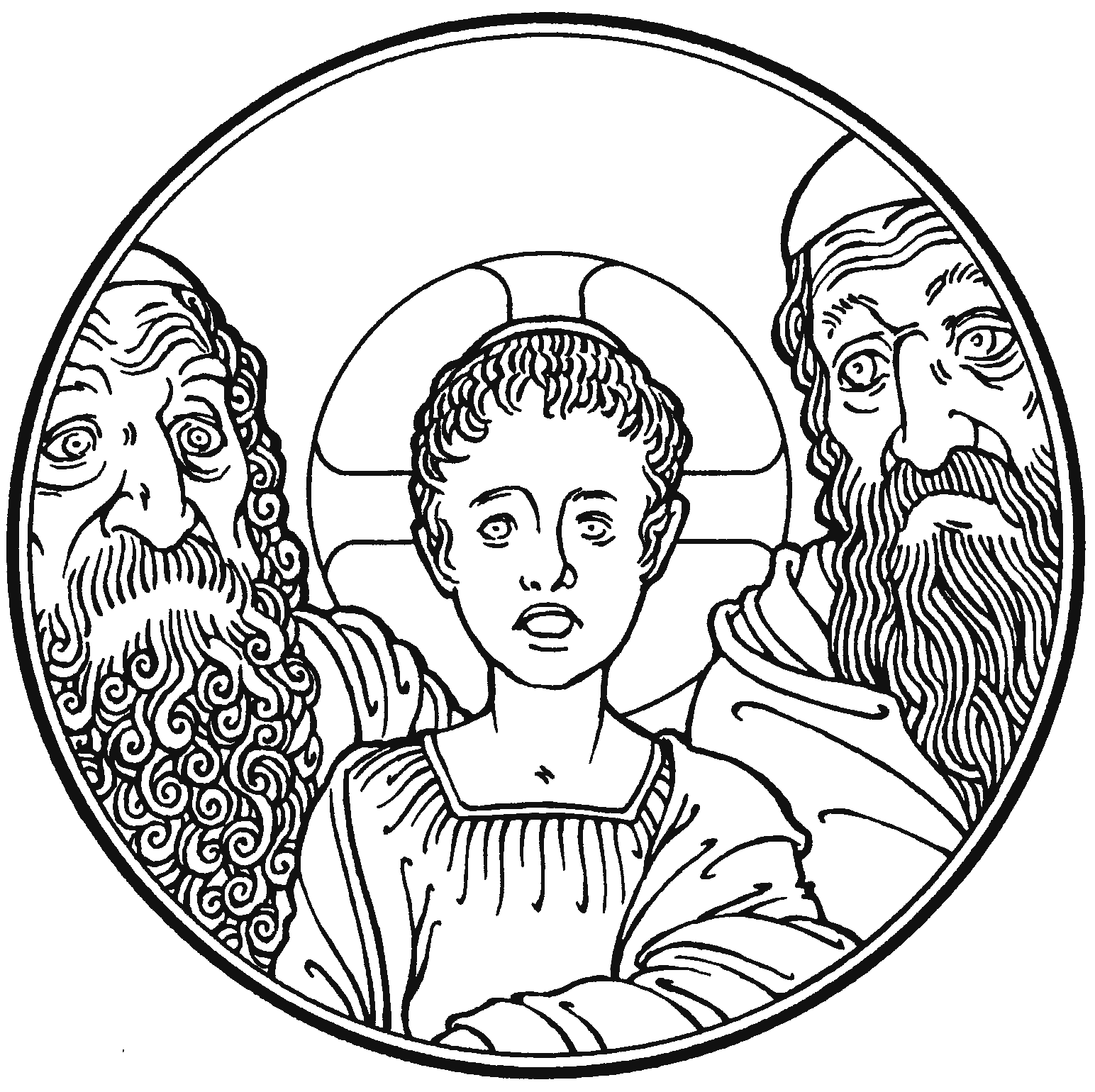
Why is it that I am the only one who preaches here on a regular basis? Why is that the congregation not take turns to preach? It all comes down to who has authority to preach and who doesn’t. As we look at our Gospel reading, we see Jesus entering the synagogue and begin teaching. But there is one problem with this picture: Jesus does not have the authority to teach in the synagogue because He is not one of the teachers of the Law. As far as authority goes, he has as much authority as the next Jewish male to begin teaching, which is none. As Mark records for us, “And they were astonished at his teaching, for he taught them as one who had authority, and not as the scribes.” What Jesus’ specific message was on this particular Sabbath, Mark does not tell us; he does tell us about the impression His preaching made on the worshipers. They were amazed, for Jesus did not teach as the teachers of the Law. They always appealed to the interpretations of past rabbis and were particularly adept at breaking down God’s Word into any number of legalistic regulations. Jesus instead always proclaimed the Gospel of God. He quoted no experts but proclaimed the good news on His own authority.

What did that say about the teaching of the scribes? What was at the heart of their teaching if it wasn’t the Gospel? Imagine the scribes when they heard Jesus teaching. What a humbling experience that must have been, or rather, should have been. Remember what was at the heart of their teaching: adherence to the Law in order to bring about salvation. Again, without knowing what Jesus said or taught, you can only imagine that it was not, “If you keep this law and that law, then you will be saved.” Rather, I imagine that the message of Jesus was all about the forgiveness that comes through the gracious mercy of God.

It is solely the authority of God that brings about salvation. It is not the authority of man. It surely was not the authority of the scribes and their strict adherence of the Law, or at least strict adherence in their own eyes. They were the ones who were trained to know what the Scriptures said. However, merely knowing what the Scriptures say and teaching what they say are two different things. One has the authority of man attached to it and the other has the authority of God.

It is no wonder that Jesus taught as one who had authority because He WAS the authority. As the very Son of God, everything that the Scriptures spoke of concerning the Messiah were fulfilled in Him. Every prophecy, every mention of salvation was the result of Jesus as the Christ, the promised Messiah.

Not only had the people gathered realized that Jesus had authority, so did a particular man with an unclean spirit. He called Jesus out on the spot, telling everyone who He was: “I know who you are – the Holy One of God.” For Jesus, the cat was out of the bag. His identity had been revealed to everyone who was there, whether He wanted it known or not. Jesus was just beginning His ministry. He had just begun to call His disciples as we remember from last week’s Gospel reading. Even there we see Jesus exercising His authority when all He has to say is “Come, follow me” and Simon, Andrew, James, and John immediately leave their boats and what they were doing to follow Jesus.

The time had not come and it was not right that the true identity of Jesus be revealed, and so He commands the demon, “Be silent, and come out of him.” As Mark records for us, the demon obeyed and left the man. Why did the demon leave the man so quickly? Why didn’t he try to put up a fight and retain his hold on this man? The answer was because Jesus had the authority and the demon did not. Jesus has all authority as He says in Matthew, “All authority in heaven and on earth has been given to me.” The words which Jesus spoke were words that commanded authority. They commanded authority because they were not His own words, but they were the words of God. They were the words of promise; they were the words of forgiveness.

Those who were gathered recognized that there was something new to the teaching of Jesus. His teaching was not the same as that of the scribes and rabbis. They recognized that what He taught had authority behind it. It wasn’t made up of fluff, of things that didn’t matter. Those people had heard the Word of God and now here they were confronted with the Word of God made flesh for them. They were amazed at the authority of His words and His work. It was teaching that was focused on the Word of God, with the authority of God behind it. Why did it have the authority of God behind it? Because Jesus Christ is the Word of God made flesh.

This authority that Jesus Christ asserts over the demon, the authority that He uses to teach in the synagogue, the authority that He uses in performing miracles; in short, the authority that He asserts throughout His life and ministry is the authority as the very Son of God.

As Jesus speaks, we see His authority in action. As Jesus speaks, something happens. Jesus speaks to the blind and they receive sight. Jesus speaks and the lepers are cleansed. Jesus speaks and the lame walk. Jesus speaks and the thief on the cross enters paradise. Jesus speaks, “It is finished,” and your sins are forgiven. It is that blessed Word of God that has such great power and authority.

Even today, we see that authority of God’s Word at work as Gary/Jude came to the waters of Holy Baptism and was made a child of God. What was it that made this possible and earned him that forgiveness? As Luther says, “Certainly not just water, but the word of God in and with the water does these things, along with the faith which trusts this word of God in the water. For without God’s word, the water is plain water and no Baptism.” It is God’s Word that gives it authority.

God’s Word is the final authority. In our case, God’s Word does not cause evil spirits to come out of us. Instead, they are words with the authority to restore. Three words, “I forgive you,” from the mouth of God, dispel all gloom and sadness and bring on joy and gladness. It is joy and gladness in knowing that we have been bought by the blood of Jesus Christ, that all of our sins have been forgiven, and that we have been given life eternal with Jesus Christ. There lies true authority: authority of Jesus Christ to forgive and to make holy. In the name of Jesus, amen. Now the peace of God that passes all understanding, keep your hearts and minds through faith in Christ Jesus, amen.
 
Leave a comment

Posted by on January 30, 2012 in Uncategorized


Tags: ,

Funeral for +Elsie Mary Bates+

LSB Icon_040The text that I have chosen for Elsie’s funeral comes from 1 Corinthians 15:51-57.

51 Behold! I tell you a mystery. We shall not all sleep, but we shall all be changed, 52 in a moment, in the twinkling of an eye, at the last trumpet. For the trumpet will sound, and the dead will be raised imperishable, and we shall be changed. 53 For this perishable body must put on the imperishable, and this mortal body must put on immortality. 54 When the perishable puts on the imperishable, and the mortal puts on immortality, then shall come to pass the saying that is written: “Death is swallowed up in victory.” 55 “O death, where is your victory? O death, where is your sting?” 56 The sting of death is sin, and the power of sin is the law. 57 But thanks be to God, who gives us the victory through our Lord Jesus Christ.

Here ends our text.

Don, Donna, Gail, family and friends, it is no mystery why we are gathered here today. Today, we lay to rest our beloved sister in Christ, Elsie. For us all, death really isn’t much of a mystery. Because of our sinful nature, we live and we die. Man’s mortality rate is 100%. As much as we would like to see happen otherwise, death is inevitable. Elsie was not immune to death. She too suffered death, but only a physical death.

Paul speaks in our text of a mystery. This is the mystery: We shall not all sleep, but we shall all be changed.” That statement was one that some in the early Church had a problem grasping. They too knew that death was inevitable and that one day, they would succumb to it. Unfortunately for some, they truly believed that death was the end. What a tragedy that was for them! These were Christians, those who confessed Christ and still didn’t believe in the resurrection. Praise be to God, Elsie was not like some in the early Church. She was a sinner, and not just any sinner. She was a sinner who was damned because of her sin, and she knew it! She knew that she deserved death and hell. Yet she also knew that on account of Christ and His life, death, and resurrection, He declared her to be not guilty and gave to her the forgiveness of her sins. Not only that, she knew that when she died, she would rise again to everlasting life because of Jesus. This was her hope, a victory made possible through Jesus Christ, God’s own Son.

Christ lived a sinless and perfect life in order that man would be saved and have everlasting life through Him. That means that Christ lived a sinless and perfect life in order that you would be saved and have everlasting life through Him. Elsie knew that because of Christ, she would be saved and have everlasting life. All those years ago at the font, when the pastor spoke those Gospel words, “I baptize you in the name of the Father and of the Son and of the Holy Spirit,” Elsie’s life was forever changed. There, she died a spiritual death in the waters of Holy Baptism and all sin that she would ever commit was forgiven.

This was accomplished for you and for Elsie solely on account of Jesus. He lived, He died, and He rose again to provide this victory. It is not accomplished by a person’s life or accomplishments. It’s not accomplished by virtue of whether or not you were a good person. This salvation that Elsie received was granted apart from her. The salvation that Jesus grants to you is given to you apart from you. The reason why it does not and cannot depend on you is because you are dead. St. Paul says, “And you were dead in the trespasses and sins in which you once walked…. But God, being rich in mercy, because of the great love with which he loved us, even when we were dead in our trespasses, made us alive together with Christ….”

Even though we are dead in our trespasses and sins, we have new life in Christ. It is granted to us without our doing anything or working for it. As Martin Luther writes, “All this He does only out of fatherly, divine goodness and mercy, without any merit or worthiness in me.” It is because Christ lives, we too shall live. It is because Christ lives, Elsie lives too.

This victory over sin and death is all according to God’s plan. As soon as Adam and Eve sinned, God began His plan for redeeming man. That plan involved one thing and only one thing: Jesus. It involved Jesus for Elsie. It involved Jesus for you. When Christ rose from the dead, God’s plan was completed. The reason why all this was done is because of the love that God has for His creation, for you. This victory that Christ has won is meant for God’s people. It is God’s will that all men come to faith and be saved. He does not want to see any perish, but have everlasting life.

That is why Christ was sent into this world, in order to save this world. The world wasn’t saved because it was good, because it was far from it. All one needs to do is read through the Scriptures to see just how corrupt mankind truly is. God punished Adam and Eve by kicking them out of the Garden of Eden. God flooded the earth because it was so sinful. God destroyed Sodom and Gomorrah because they were so sinful. Mankind is inherently sinful and there is nothing redeemable about us, yet God chose to send His Son to live and to die to redeem us.

Out of love for His creation, God sent Jesus. It surely wasn’t because of anything on the part of man. It wasn’t on account of anything that Elsie did in her life. She knew that about herself. She knew that she was a condemned and damned sinner who deserved hell, but on account of Jesus, she knew that she was forgiven. She knew that she was forgiven because Jesus died for her sins. She knew that she would never be able to achieve salvation on her own and she solely relied upon Jesus to grant to her the forgiveness of sins which she so desperately needed, something which you and I so desperately need.

For those of us who remain, there will indeed be sorrow today, for an important part of our lives has been taken away from us: a wife, a mother, a grandmother and a great-grandmother, and a friend. For as much sorrow as we might express, we should express an equal amount of joy in knowing that our Lord has called Elsie to be with Him. Our joy lies in knowing that one day, we too shall gaze upon the face of Jesus when we enter that heavenly paradise which Christ has prepared for us with His own blood shed for the forgiveness of our sins. Our joy lies in knowing that one day, we shall gaze upon the face of our sainted sister Elsie, who has received that glorified and perfect body. While we mourn today, we look to that joy that we have forever because of Christ, a joy in knowing that we will be with those who have died in the faith, but more importantly, a joy where we will be with Him. Don, Donna, Gail, look to Jesus, for He alone can give victory, a victory that He has granted to Elsie and a victory that He grants to you as well. Amen.

 
Leave a comment

Posted by on January 27, 2012 in Uncategorized


Tags: ,

Epiphany 3–“Repent, Believe, & Follow” (Mark 1:14-20)

B-20 Epiphany 3 (Mk 1.14-20)Grace, mercy, and peace to you from God our Father, and from our Lord and Savior, Jesus Christ, amen. The text for the sermon is the Gospel, which was read earlier.

The clock and calendar dictate much of our behavior. It’s time to eat; time for the news; time for school; time to go to work; time to start working on taxes. The new year has already lost its magic glow as our new year resolutions have already been broken. Time is the eternal taskmaster and everything must take place at the appointed time or else everything falls apart.

Jesus too follows time and follows it to the letter. Everything He does happens at exactly the right time, not a moment before or a moment after. What occurs in our text is no different. Jesus says, “The time is fulfilled, and the kingdom of God is at hand; repent and believe in the gospel.” Did you catch the first command Jesus gives in Mark’s Gospel? First, He says the time is fulfilled and the kingdom of God is at hand. The time has come; not a moment too early and not a moment too late. Then comes Jesus’ command: repent. Repent is the first thing Jesus tells people to do. That word becomes the key word whenever He meets someone. It’s kind of a summary of what He taught, what He preached, what He wanted His miracles to bring about in people’s lives.

When Jesus uses the word repent, He is calling people to turn away from anything that leads away from Him and to turn instead toward Him. What difficult thing repentance is, to turn away from what is contrary to the Word of God. Just what exactly is contrary to the Word of God? In short, the world. What the world teaches and preaches often runs contrary to God’s Word. The world says it’s okay to do any number of things that the Word of God condemns. It’s is so difficult for us to abide by God’s Word when we are told by the world that what we’re doing is okay. But regardless of what the world says, God’s Word is the ultimate authority and Jesus says to repent. That’s not the only command Jesus issues. His second command is believe. Believe not just anything, but believe in Jesus. Trust Him. Turn toward Him. Hold on to Him.

Repent and believe is the heart of Jesus’ message when He speaks or does something. He says and does much more, but this is the gist, the summary, the heart of His ministry: repent and believe. Repent of sin. Believe, for He has come to remove it. And He will!

The time had been fulfilled with the coming of Jesus. Since Jesus arrived on the scene, the prophecies from the Old Testament were fulfilled in Him. All of history now hinges on what Jesus would do. And what exactly would Jesus do? He would come to live a perfect life for you because you live an imperfect life. He would come to die a sinner’s death even though He was sinless. He would rise again to eternal life in order to give you eternal life. This is what Jesus would come and do and this is what Jesus did for you. He did it, the action is already done. There is nothing to be done on your part because Christ has already done it. The only thing Jesus requires of you is to repent and believe.

Jesus calls for us to repent. He says to take responsibility for what you have done wrong. We call that confession, coming before Him with repentant hearts seeking His forgiveness. That is why we confess our sins each week, turning away from the sin in our lives and turning toward the forgiveness that Jesus gives. But we don’t just confess our sins on Sunday, as if we have only sinned that morning. We need to confess our sins daily for we sin daily. We need to turn away from our sinful lives and turn to Jesus and His forgiveness daily.

Jesus issues a third command in our text, one that He issues to Simon, Andrew, James and John: “Follow me, and I will make you become fishers of men.” There, Jesus calls them to become His disciples. That same command Jesus gave to them He gives to you as well. In your Baptism, He calls you and says, “Follow me.” We follow Jesus, not out of compulsion or a sense of righteousness on our part, but we follow Christ because of the mercy that He has shown us. We follow Christ; we become His disciples because of what Jesus has done for us. We follow Him to the cross where we see Him take our sin upon Himself, giving to us His righteousness. We follow Christ as He proclaims eternal victory over sin, death, and the devil on account of His life, death, and resurrection. We follow Christ to our heavenly Father, who sent His only begotten Son to restore His creation to what it was meant to be: holy and perfect.

This command of Jesus to follow Him is not a command that is to be taken lightly. To follow Jesus means first of all to subordinate everything to the Lord. Give yourself, your heart, mind, and soul to Jesus.

To follow the Lord also means that one will strive to simulate the Savior in all His ways, to be holy! St. Peter writes, “But as he who called you is holy, you also be holy in all your conduct.” Your attitude should be the same as that of Christ; that is, we should love and forgive unconditionally, just as St. Paul writes, “Be kind to one another, tenderhearted, forgiving one another, as God in Christ forgave you.”

Finally, to follow Christ means to share the work of Christ. This point receives a mighty emphasis in Jesus’ statement, “I will make you become fishers of men.” The preaching of the Gospel was Jesus’ highest priority. His Gospel was more important than eating and drinking, than healing and miracles, than any personal comfort. The Gospel is this: Believe in Jesus, who suffered your hell in your place, and you will be saved. Jesus was determined to fulfill that Gospel and to proclaim that Gospel to sinners. His followers will share that commitment throughout their lives.

Today, our Lord calls to you. He calls you to “repent and believe in the gospel.” He calls you to repentance out of the love that God the Father has for you, His beloved creation. He calls you to repentance out of the love that He showed for you on the cross when He took upon Himself all of your sins. He calls you to believe with the faith granted to you in your Baptism through the work of the Holy Spirit. He calls you to believe in the promises that He has made to you and for you, promises such as, “I will come again and will take you to myself, that where I am you may be also,” and “Truly, I say to you, today you will be with me in Paradise.” Our Lord calls you to follow Him. As baptized believers, we follow Him from death to everlasting life. In Jesus’ name, amen. Now the peace of God that passes all understanding, keep your hearts and minds through faith in Christ Jesus, amen.

 
1 Comment

Posted by on January 22, 2012 in Uncategorized


Tags: ,

Support and Love, Patience and Wisdom

The following is a quote from the Rev. Dr. Dean O. Wenthe from 1979. I find it very appropriate even today.

Our primary calling as theologians is to interpret reality for ourselves and for our people. In our day, we behold the tragic paradox of secular man seeking something more solid than the phony, penultimate, pleasure trips, of either the gross or more refined variety, that are constantly held before us as the only route worth traveling…and, in their seeking, find no one to speak to them of that which is solid and real. The saints whom you serve will at times overwhelm you with their support and love. The sinners whom you serve will at times send you scampering to the throne of grace for more patience and wisdom than your flesh can muster. And yet, on this latter point, I can forthrightly say that for all their frailties you will find your flock a joy to serve. I was simply not prepared for all that closeness which is forged between Pastor and people as they seek to live a real life in the midst of a phony world. Frankly, it’s great! And if these tasks do not plant the seeds of joy and happiness in our service, then we have ourselves drifted from that which is real.

Concordia Theological Quarterly 75, p. 367-368


Tags: ,

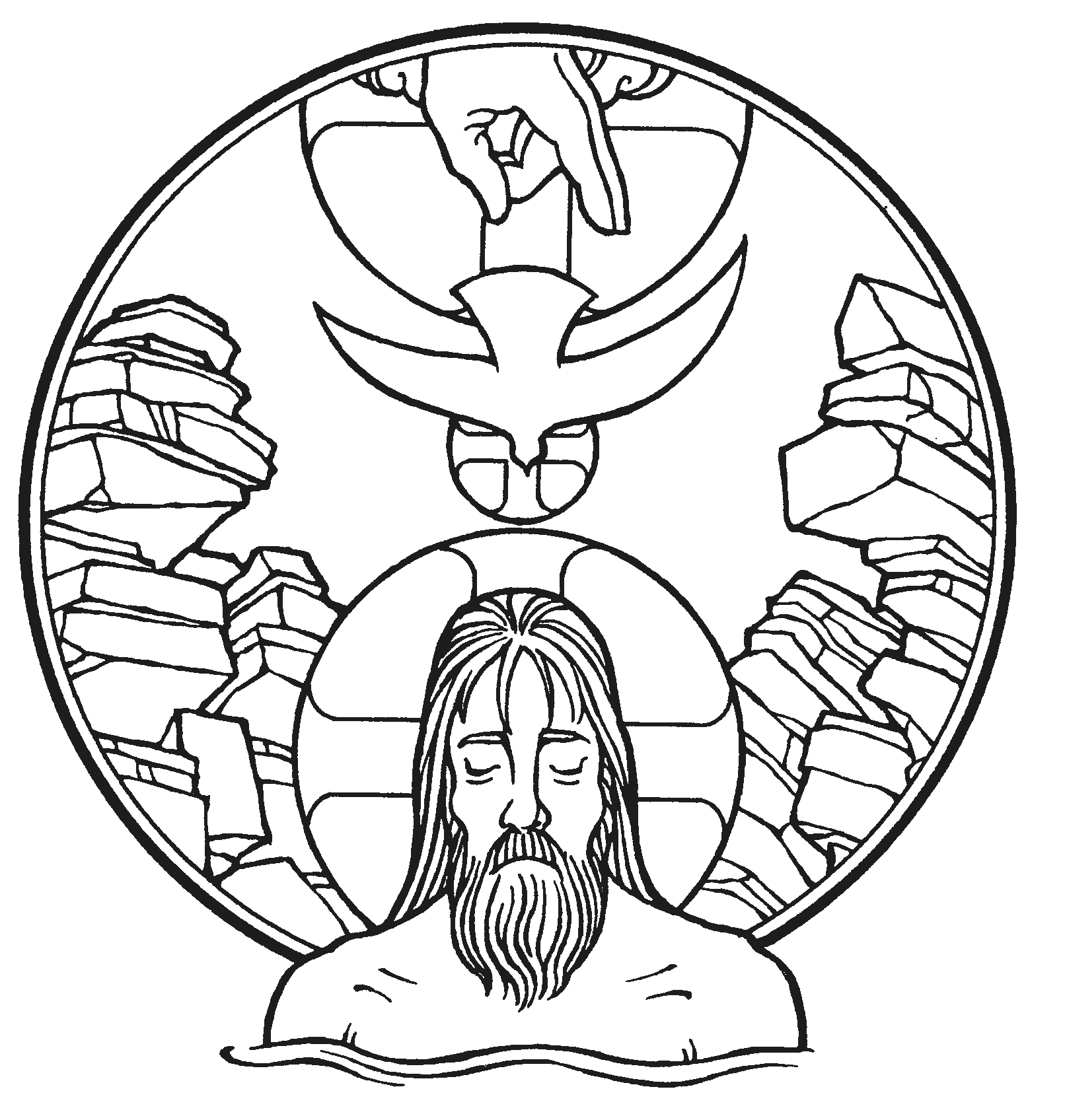
Baptism of Our Lord–“Gift of Baptism” (Mark 1:4-11)

B-18 Epiphany 1 (Mk 1.4-11)Grace, mercy, and peace to you from God our Father, and from our Lord and Savior, Jesus Christ, amen. The text for the sermon is the Gospel, which was read earlier.

Christmas is over. With it, we saw the coming of our Lord. He came to us in the form of a babe, lying in a manger. The Christ Child was brought to the temple to be presented. There, Simeon spoke the words of the Nunc Dimittis to Mary and Joseph. Simeon had seen the salvation of the Lord, which has prepared in the sight of all people. We have heard what John has said: “And the Word became flesh and dwelt among us, and we have seen his glory, glory as of the only Son from the Father, full of grace and truth.”

All of that brings us to today. Today we meet John again. Here we find him in the desert preaching about a baptism of repentance for the forgiveness of sins. While he was doing this, he had a message: “After me comes he who is mightier than I, the strap of whose sandals I am not worthy to stoop down and untie. I have baptized you with water, but he will baptize you with the Holy Spirit.”

So what does all of that mean? Why should I care? Well, you have John. He came as the fulfillment of the Old Testament passages concerning the second Elijah, the immediate forerunner of the Christ. John preaches a simple message: Jesus as the promised Messiah. He focuses on the necessity of repentance for receiving Christ aright, on the person of Christ as both God and Savior, and on Baptism for those who sincerely repented and believed in the Messiah. John also alludes to the Baptism with the Spirit and with fire that Christ will give to His people to carry out His saving mission in the world. John’s Baptism, too, worked forgiveness of sins, delivered from death and the devil, and gave eternal salvation to all who believed.

So we come to the focus of John’s Baptism: repentance. Are you truly repentant for your sins? Are you sad that your sins caused a Baby to be born, so that 30-some years later, He would die on the cross for you? It’s a hard question to ask. True repentance means not only sorrow over sin and dread of God’s punishment, but a turning of mind and heart away from sin that expresses itself in outward ways wherever possible. True repentance will not allow the penitent soul to continue to live in sin.

You see, John came and he went. He went to the desert region and baptized people. Why did he do that? No one told him to do it. He did it because he knew that the people were repentant of their sins and that by being baptized, the Old Adam would die and when you emerged from the waters, you were a new person.

The early Church had an interesting way of baptizing. They had a huge baptismal font. You would descend the stairs to the font. That symbolized your dying to sin. Once at the bottom, your clothes were removed and you were baptized. You then ascended the stairs as a new person. Who you were before died in the waters of Holy Baptism. That is the same thing that John did in the desert. John knew that there was One coming more powerful than he was. He knew that he was only a preview of the joy that would come.

John eventually moved to the River Jordan. There, he met Jesus and an interesting turn of events took place: Jesus comes to be baptized by John. Jesus is the Messiah, the Son of God; He had no sins to confess! Why did Jesus need to be baptized for the remission of His sins that didn’t exist? Matthew records for us Jesus’ simple reply to John when John questions the Baptism: “Let it be so now, for thus it is fitting for us to fulfill all righteousness.Then John baptized Jesus.

Can you imagine Jesus coming up to you and saying, “Bob, it’s time for you to baptize me now?” How would you react? What would you say or do? We see in our text just how easy it was for John to question and do what he did. And when Jesus came out of the water, heaven was torn open and the Holy Spirit came to Him and dwelt with Him. Did Jesus have to be baptized? Was it mandatory for that to happen? No. In allowing Himself to be baptized, Jesus was showing His solidarity with sinners. Though Himself sinless, He was identifying Himself with sinners by giving Himself to the work of bearing their sins then and our sins now.

We need to make sure we fully understand what took place in the Baptism of Jesus by John. The view that by being baptized by John, Jesus only showed His willing obedience and that Jesus, though not needing baptism and yet submitted to it, makes the baptism nothing but a formality and misconstrues what John’s Baptism really was. It was not law, but gospel, not a demand to obey but a gift of grace to accept and to retain as such. Jesus was baptized by John because He regarded this as the right way in which to enter upon His great office. He, the Sinless One, the very Son of God, chose to put Himself by the side of all the sinful ones, for whom this sacrament of John’s was ordained. He signifies that He is now ready to take upon Himself the load of all these sinners, that is, to assume His redemptive office. As Luther points out, Jesus was here rightly beginning to be Christ, the Anointed One, and “was thus inaugurated into His entire Messianic office as our Prophet, High Priest, and King.”

Every time we celebrate a Baptism, the one being Baptized is made a child of God by the waters of Holy Baptism, and every sin that they will ever commit will be washed away by those waters, just as it was earlier with Averyanna. That person receives sonship in the kingdom of God. Their sins are forgiven. How is this done? It is done by a man named Jesus, sent from God to be our sacrificial Lamb, baptized in the waters of the Jordan River, forever joining Himself to sinful man in order to redeem us. It is accomplished for us by His death on the cross for us sinners. It is accomplished for us only by Jesus who has atoned for all our sins. In Jesus’ name, amen. Now the peace of God that passes all understanding, keep your hearts and minds through faith in Christ Jesus, amen.
 
Comments Off

Posted by on January 10, 2012 in Sermons


Tags: ,

Home

20120106-205255.jpgThis was the sight that I walked in to when I got back to the hospital after Wesley woke up from his nap. Gwen was waiting for the discharge papers to be completed and Bryce was as happy as could be. He could finally walk (he had monitor wires on his left foot) and get down from the bed. About 30 minutes later, we were led out of the hospital by his nurse on shift and we made our way home. Gwen took the boys and I went to Walmart to get 4 prescriptions filled. When we got home, he was happy as could be and running around and playing and even jumping on the mini trampoline.

I’m definitely glad to have all of my family home and my boy on the mend. Hopefully we won’t be making any more trips to the walk-in clinic, ER, and/or the ICU any time soon.

 
Comments Off

Posted by on January 6, 2012 in Bryce


Bryce and the croup

This last week, Bryce has had croup. It was bad on Monday and Gwen wanted to take him to the doctor’s office, but it was closed due to the holiday. She ended up taking him to the ER, but it was a 4-6 hour wait, plus they were waiting for a series of ambulances to come.

Tuesday she took him to the doctor and they gave him a steroid shot and said he should be feeling better within three days. Yesterday was day two and he actually sounded worse than before. Gwen took him to the walk-in clinic last night. She was there less than 30 minutes and they called an ambulance for him. His O2 stats were in the 80s which is not good. He was also sciatic (his lips were blue in color). The ambulance trip was only about 2 blocks away, so that’s going to be an expensive taxi ride!

At the ER last night, they gave him some IV fluids and he started to perk up. Gwen called me and I got up there and he was still puny looking but better than what he was at the walk-in clinic. This is what he looked like.

20120106-135904.jpg

Wesley and I spent the morning up at the ICU. Bryce really perked up and seemed to be more of his regular self. Starting at 1pm, they were transitioning him to oral medication and if all went well, he should be discharged tonight. This is what he looked like around 6:30 this morning.

20120106-140010.jpg

 
Comments Off

Posted by on January 6, 2012 in Bryce


Circumcision and Name of Jesus–“All About the Name” (Luke 2:21)

F-6 Circumcision and Name  (Lu 2.21)Grace, mercy, and peace to you from God our Father, and from our Lord and Savior, Jesus Christ, amen. The text for our sermon this morning is the Gospel reading, which was read earlier.

In our Gospel lesson for today, a single verse speaks volumes about what’s in a name: “And at the end of eight days, when he was circumcised, he was called Jesus, the name given by the angel before he was conceived in the womb.”

Going back to the angel’s appearance to Mary, she was told about the Child she was to have, whose name would be Jesus. “And behold, you will conceive in your womb and bear a son, and you shall call his name Jesus. He will be great and will be called the Son of the Most High.” Mary already knew what she was to call her Son; Jesus, which means “help of Jehovah” or “savior.” His name signified what His mission in life is: the helper of Jehovah or God, savior of mankind.

The name Jesus was not an uncommon name. It is used of other men in the Bible, most notably and prophetically of the leader of Israel who led the people of God into the promised land of Canaan, Yeshua, or who we know as Joshua. Here this common name is used for an uncommon person, who is Himself the Lord who saves!

While today is New Year’s Day, it is also the day of Christ’s circumcision, eight days following His birth, where He would receive His name. The circumcision and naming of Jesus is the scriptural subject for the festival of New Year’s Day, a day that has increasingly become more secular than sacred.

The full meaning of Christmas is not just found in the fact that the Word was made flesh, but also in the purpose for which He entered our flesh and blood. Already on the eighth day of His earthly existence, His blood flowed. As it flowed, it was both a sign and promise of the redemptive blood of Calvary, which was the goal and purpose of Bethlehem.

The Child whose birth was recorded in the opening verses of Galatians 4 had come to fulfill the law. “But when the fullness of time had come, God sent forth his Son, born of woman, born under the law, to redeem those who were under the law, so that we might receive adoption as sons.” There we see what Jesus came to do: He fulfilled the Law to establish the Gospel.

This fulfillment was to be perfect. Therefore, meticulous attention to the Lord’s command is revealed with the words, “And at the end of eight days, when he was circumcised…. God had said circumcision should be performed on the eighth day dating all the way back to Genesis, so the eighth day it was. He who had come to do His Father’s work did His Father’s will with delight.

Why should we make a big deal about the circumcision of Jesus? What is the significance of that? The rite of circumcision was given to Abram as the sign of the covenant between God and man. Circumcision was a God-ordained sign of the promise of the Savior, an outward sign signifying one’s membership in God’s covenant family. Submitting to circumcision would be an outward confession of faith that one believed God’s promise and wanted to be included among His people. Parents having a child circumcised were likewise confessing their faith in and obedience to God in the same way that Christian parents do when they bring their children to baptism today. In the same way, the Old Testament parents were to train their children to know the Lord whose gracious covenant they had received. They were also to watch that their children reflected their covenant relationship with God by circumcising their lives from sin. Without that inward disposition of the heart, the outward mutilation of the flesh was nothing.

Our Lord Jesus was not born in sin, and did not need that mortification of a corrupt nature, or that renewal unto holiness, which were signified by circumcision. This ordinance was, in His case, a pledge of His future perfect obedience to the whole law, in the midst of sufferings and temptations, even unto death for us. He came to shed His blood for us, to redeem us from sin and death.

The crowning point of everything was not the rite of circumcision itself, but the royal name bestowed upon Him who received it. That name was Jesus, which means Savior, but not merely Savior. It also means “the Lord saves.” And that is what Jesus Christ came to do. He was not born so that He would be a carpenter. While He was the Son of a carpenter, that was not His purpose in life. His purpose was to come into this world, as broken as it may be, and heal it. He came to grant forgiveness of sins and to bring all people into His Father’s house. His life was a selfless life, disregarding His own wants and desires to do His Father’s will: to die, to be resurrected, to grant new life to all those who profess the Name of Jesus Christ.

The name of this Child and the name God or Lord are not just sounds, but sounds filled with meaning. The name of the Lord is His reputation. He made that name known to Moses: “The LORD, the LORD, a God merciful and gracious, slow to anger, and abounding in steadfast love and faithfulness, keeping steadfast love for thousands, forgiving iniquity and transgression and sin, but who will by no means clear the guilty, visiting the iniquity of the fathers on the children and the children’s children, to the third and the fourth generation.”

His name tells us what He came to do. Jesus is the one who lived up to His name by living, dying, and rising from the dead. Jesus is the one who saves us from our sins. The little bit of blood that Jesus shed for us at His circumcision was only the beginning. The day would come when He would shed His blood and give up His life. In this way He would save us from our sins, for “the blood of Jesus [God's] Son cleanses us from all sin.” In the name of Jesus, amen. Now the peace of God which passes all understanding, keep your hearts and minds through faith until life everlasting. Amen.

 
Comments Off

Posted by on January 1, 2012 in Uncategorized


Tags:

Pastoral Year in Review – 2011

2011 proved to be a year of change for me pastorally. In April, my senior pastor took a call to another church, leaving me as the only pastor. Our church was in a state of limbo from mid-April to mid-August while we evaluated our options as far as our ministry staff was concerned. Things solidified on August 18 when our Voters’ Assembly decided to call me to be the sole pastor of Trinity. So, here are the vital stats for 2011:

Sermons: 53
Weddings: 2
Funerals 7
Baptisms: 5
Junior Confirmation: 15
Adult Confirmation: 3

2011 was a definite change for me pastorally. In 6 years, I’ve never preached every Sunday since there have been 2 pastors here. For the last 8 months, that’s what I’ve been doing. Most of my other pastor friends have been doing this since Day 1 so I’ve been spoiled.

The month of December proved to be a very busy and emotionally taxing month. I had 3 funerals in a span of two weeks with Advent and Christmas rolled in there. Our Christmas Eve and Day services had 4 services (3 sermons) in 2 days. Needless to say, my post-Christmas staycation has proven to be much needed.

So, that’s it. That’s 2011 in the books. Here’s to a new year.

 
Comments Off

Posted by on December 31, 2011 in Year in Review


Tags:

Maintenance

My site is currently undergoing some maintenance. Keeping it on WordPress, just moving it to .com hosting instead of .org hosting. Please bear with me. All posts are there, just no graphics.

 
Comments Off

Posted by on December 29, 2011 in Technology


Follow

Get every new post delivered to your Inbox.

Join 939 other followers